If you hang around any exec team that I coach/lead, you are bound to hear someone ask, “Are we chasing the yes’ or the no’s?” at some point during team debates/discussions. Asking the question is a habit I condition leaders to develop in our work together. I believe it’s a staple in being a great servant leader. In essence you are asking, “Are we planning/thinking in a manner that is aligned with what we want to happen or what we don’t what to happen” or “Are we thinking based on the actions/reactions of the people whose behaviors we want to replicate and grow or based on those we do not”?
Team Players say yes!
Who are the Yes’?
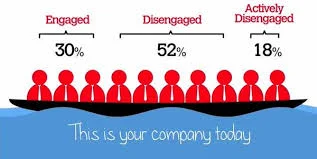
I have experienced leading a founder and as a successor. Without fail, three groups form/exist among the team you build or inherit: the yes’, the no’s, and the ‘undecided until further notice’ (folks who wait to see who will win and choose the safe side). The leaders response typically determines if/how they thrive. It doesn’t matter what you label or call the groups. The division is as follows:
Team Players say, “Yes!” They are your ‘ride or dies’ in the organization. They believe in the mission, they are committed to their leaders (in support of the fulfillment of said mission), and they are willing to roll with the punches—known and unknown. They question for clarity, guidance, or support, and their intentions are genuine. They are all-in so to speak.
-Negative Normans say, “No!” No matter what, these people will find a reason to disagree or find fault with whatever is being asked of or given to them. They walk about with a dark cloud of pessimism over their heads and seek to spread it to others. You can’t please them, and you will be wasting your energy chasing or attempting to change them. Make no mistake, they deserve a strategy devised with HR, but they should not be he basis for how you plan or treat the other members of the organization. I’m not saying that people can’t change or improve, but Negative Normans are cancers. Unaddressed cancers don’t just disappear or stop. By its nature, cancer spreads when unaddressed (or ignored) and has the potential to take you out of the game if not handled in timely and proper manner.
-The Undecideds say, “It depends…” These folks just don’t want to lose. Be it politics or their lack of strength/will. They can be your best performers. They can be your model employees, but they hide their voice and they will not use it to support the leaders agenda. When it is time to take a stand/side, they are quiet and avoid sharing any successes/positives as much as possible. If they believe there is power/safety among the negative, they will sit with the Normans just to fit in. They will only tell of the meaningful guidance, support, and positive reinforcement they receive when probed—maybe.
Where We Go Wrong
These dynamics are often unavoidable, and they creep up among the best teams and organizations. The healthy path forward has to include consistently chasing the yes’. If you believe that what you focus on expands, then you can’t get bogged down with the negative and allow it to shade your thinking, planning, strategizing. Much more, the speed of the leader typically equals the speed of the team. If the leader has allowed toxic energy to slip in and impact decision-making, she will be doomed when those who follow her begin behaving poorly alongside her example.
It is also felt by the employees under your charge. We’ve all been the kid who wasn’t doing the undesired thing that got recess cancelled for the entire class. Even more relevant, we’ve all experienced the staff meeting where the leader is railing on everyone because of a few people who are not compliant with some expectation. It sucks and it drains the life out of the room/group. In that same way, policy and strategic decisions need not be driven by a desire to avoid or punish your Negative Normans.
I once took over leading and discovered that all of our salaried employees were required to “clock-in”. This was a surprise as I have never had to punch a clock as a salaried employee and didn’t plan to start. When I asked about why we were investing in this software (that broke down and creating reporting inaccuracies), I was told that at one of our five work centers, there were some people who once claimed to be at work but were out getting coffee. I was baffled. Our only solution to the poor decision making of a few people (No’s) was to create a new policy, invest in software and machinery, and begin managing a process that irritated hundreds of other employees? The leaders of the organization had not been leading with chasing the yes’ as their top priority, and too often this is the case where leaders struggle/fail.
Do It…Anyway
As it was with recess, so it is in your current leadership situation. Mother Theresa’s infamous call to “Do it anyway” likely frames it best. If your intentions are right and pure, honor them. I recall a time years ago when I was paling around with a fellow CEO about my frustrations with leading a mixed bag of folks at the time. He listened, empathized and said, “Order the pizza anyway.” “Say more,” I responded. He went on, “No matter what you do you’re going to have people who find a reason to complain. If you surprise your team with pizza for lunch, someone is going to find a reason to complain, “You didn’t tell me in advance….” Order it anyway.” His words connected, and I knew his push was right. I needed to focus my energy on staying true to myself.
Take care of your people No matter where I go, this is always a part of my strategy. Listen and understand what is missing from the lens of the people you serve and build a plan that seeks to demonstrate your commitment to responding to any expression of need as well as repairing any lingering damage of former leadership. Do the extra things that express kindness and gratitude to model and grow the things you want to see in others. Collect data regularly and then follow up/through with feedback as a rule.
You can’t control the Normans and typically their negativity is not about you. My good leader friend loves to remind me, “Don’t wrestle with pigs…you’ll get dirty and the pigs will like it.” It sucks when you know you have good intentions toward people and are working to turn the tide for the better, yet you continue to bump up against the Normans of the world. Still, you can’t shift your focus and energy in that direction. Don’t get me wrong, does it call for structured redirection? Yes. I don’t believe in the ostrich play at any time for any reason. But should it drive policy or work practices? Absolutely, not. Deal with your Normans directly and individually.
By chasing the yes’ you create safety for your undecided folks, and that group will grow. You’re the leader. Chasing is about empowering. Your communication and reinforcement will let everyone around you know what matters, and though it will take time and consistency, you can eventually win the others over by thinking of how you retain/grow the good vs. how you annoy/challenge the bad.
Is that all you have to do, chase the yes? Of course not, but it’s critical where you are aiming to start/make/grow health in an organization. There is so much more in my bag of leadership skills/tricks, but I have to start somewhere.
Keeping it real, true, and free,
Garland Darling
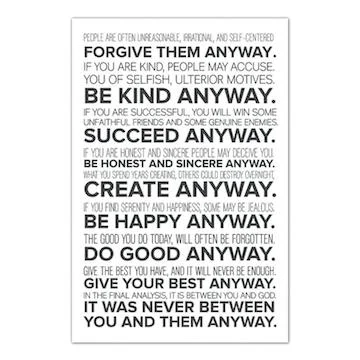
Mother Teresa was the founder of the Order of the Missionaries of Charity, a Roman Catholic congregation of women dedicated to helping the poor. Considered one of the 20th Century's greatest humanitarians, she was canonized as Saint Teresa of Calcutta in 2016